



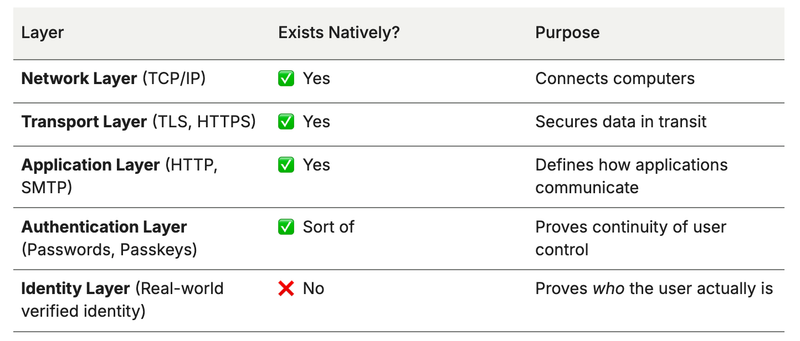
The identity layer — the part that says “who is this person, really?” — does not exist natively in the web’s design. Let’s unpack what that means and why it’s such a big deal
The internet’s original design (TCP/IP, DNS, HTTP, etc.) connects machines, not identities.
- IP addresses identify computers or networks.
- Domain names identify servers or websites.
- HTTP sessions identify browser connections.
None of these say who the human behind the connection is. So from the ground up, the internet gives us: “This device is talking to that server.” Not: “Alice Smith is talking to PayPal.”
Identity got bolted on later — inconsistently
Because the core internet protocols didn’t include identity, every application had to invent its own way to identify users:
- Websites use usernames and passwords.
- Apps use email or phone verification.
- Enterprises use LDAP or Active Directory.
- Social media use OAuth (“Sign in with Google / Facebook”).
The result is fragmented, redundant, and insecure identity handling — every app has its own database of who you are. That’s why:
- You have hundreds of separate logins.
- Data breaches are constant.
- “Identity theft” is even possible at all.
If the web had a native identity layer, most of that wouldn’t happen.
So what do we actually have?
We have authentication systems, not an identity layer. So the internet can authenticate — but it can’t identify anyone by default.
Why this matters (and why people keep trying to fix it)
Because there’s no identity layer, we get:
- Fake accounts, bots, spam
- Data silos and password fatigue
- Fraud and impersonation
- Poor user experience across platforms
This has led to decades of attempts to “add” an identity layer on top of the web, like:
- OpenID / OAuth e.g., “Sign in with Google”
- SAML / enterprise SSO
- Decentralized identity (DID) and verifiable credentials
- Self-sovereign identity (SSI) projects
- Government-backed digital IDs (e.g., EU Digital Identity Wallet, eIDAS 2.0)
Each is trying to retrofit the missing piece: A standard, portable, privacy-preserving way to prove who you are online.
What a true “identity layer” would mean
A genuine identity layer would:
- Let users control their verified credentials.
- Let websites request identity proofs (e.g., “over 18”, “verified professional”).
- Allow cryptographic authentication tied to those proofs.
- Work across platforms and borders.
Think of it as a global digital passport system — decentralised, privacy-preserving, and cryptographically secure. We’re not there yet, but initiatives like W3C Decentralized Identifiers (DIDs) and Verifiable Credentials (VCs) are heading that way.